Behavioral and Dress Etiquette
Question
Who can come to the Nuptial Mass?
Answer
The church can only seat 300 people, so Ushers will give preferential seating to invitation holders. However, if you don't mind sitting in the back or possibly standing, anyone is welcome to attend our Nuptial Mass.
Question
What is a "Nuptial Mass"?
Answer
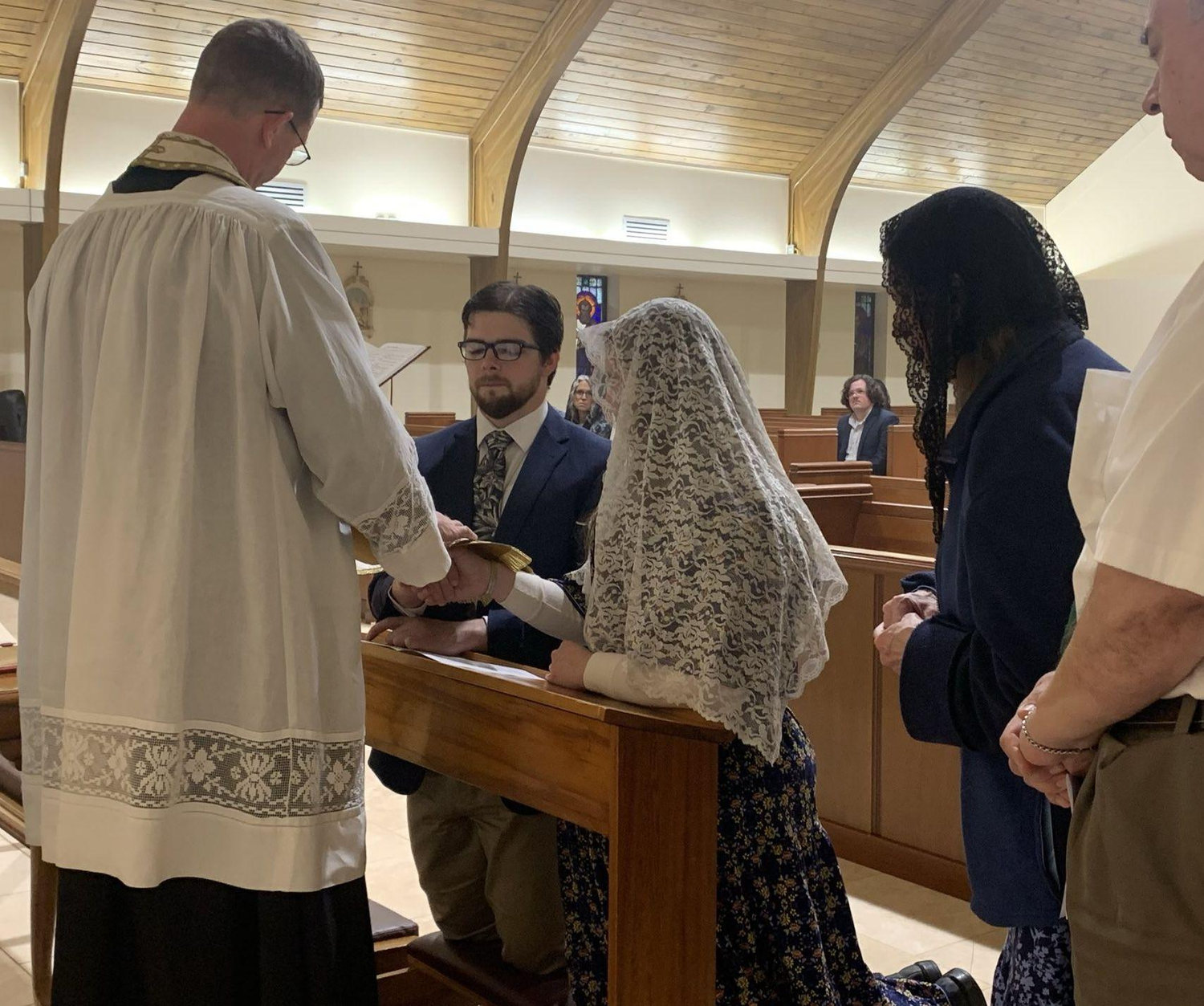
In the Traditional Roman Rite, the nuptials (i.e. the exchange of vows between the couple) occur at the beginning of the service and are followed by the Holy Sacrifice of the Mass. Marie and Odie's nuptials will be celebrated according to this 1962 tradition, where their vows will be followed by a High, Tridentine Latin Mass, so the entire service will take roughly one and a half to two hours.
Question
What should I do at the Nuptial Mass?
Answer
There will be handouts available to help all guests follow/pray along as members of the congregation. These handouts will also indicate when to sit, stand, and kneel. When in doubt, please maintain a reverential silence and offer up your prayers for the happiness and holiness of the newlyweds! Talking/socializing is not permitted in the Sanctuary. Please step into the foyer or outside before speaking.
Question
Who can come to the Reception?
Answer
This is a closed event. Only those with invitations to the reception and who RSVP-ed for it can attend.
Question
When should I RSVP?
Answer
Due to the large number of guests we are expecting, you will need to RSVP by February 18.
Question
How should Men dress for the Wedding?
Answer
Gentlemen - Suit or jacket and tie, dress pants/slacks, preferred. • More casual attire permitted, but no shorts or flip-flops. • No clothing with improper/excessive writing, pictures, or advertizing either on front or back. • No ripped or frayed clothing. - No hats inside the Church. - No gauges, earrings or other piercings. - Tattoos covered as much as possible. • This includes wearing long sleeves to cover forearm tattoos. PLEASE BE ADVISED that gross failure to comply with the specified dress code may result in denial of entry. We appreciate your attention to this request.
Question
How should Women dress for the Wedding?
Answer
Ladies - Dresses and Skirts are highly encouraged. • Hems (be they of dresses, skirts or slacks) must fall below the knees when standing and sitting. • No revealing slits in skirts/dresses. - Dress pants/slacks are permitted, but no jeans or ripped clothing. • No shorts or leggings except under a proper skirt (see above). - No low-cut, see-through, or skin tight clothing. - No sleeveless, bareback, spaghetti straps, tube or tank tops. - Head coverings (either veil or hat) are highly encouraged in the Sanctuary. - No piercings, apart from the ears, or gauges. - Tattoos covered as much as possible. • This includes wearing long sleeves to cover forearm tattoos. PLEASE BE ADVISED that gross failure to comply with the specified dress code may result in denial of entry. We appreciate your attention to this request.
Question
How should Men dress for the Reception?
Answer
Same as the wedding, but slightly less formal attire is acceptable.
Question
How should Women dress for the Reception?
Answer
Same as the wedding, but slightly less formal attire is acceptable.
Question
When can I clap/cheer for the newlyweds?
Answer
~ NOT at any point during the Nuptial Mass NOR in the Sanctuary/church. ~ ANYTIME outside the church and/or at the Reception!
Question
Can I receive Holy Communion if I'm Catholic?
Answer
USCCB Guidelines state: For Catholics - As Catholics, we fully participate in the celebration of the Eucharist when we receive Holy Communion. We are encouraged to receive Holy Communion devoutly and frequently. In order to be properly disposed to receive Holy Communion, participants should not be conscious of grave sin and normally should have fasted for one hour. A person who is conscious of grave sin is not to receive the Body and Blood of the Lord without prior sacramental confession except for a grave reason where there is no opportunity for confession. In this case, the person is to be mindful of the obligation to make an act of perfect contrition, including the intention of confessing as soon as possible (canon 916). A frequent reception of the Sacrament of Penance is encouraged for all.
Question
Can I receive Holy Communion if I'm a non-Catholic Christian?
Answer
USCCB Guidelines state: For our fellow Christians - We welcome our fellow Christians to this celebration of the Eucharist as our brothers and sisters. We pray the our common baptism and the action of the Holy Spirit in this Eucharist will draw us closer to one another and begin to dispel the sad divisions that separate us. We pray that these lessen and finally disappear, in keeping with Christ’s prayer for us “that they all may be one” (Jn. 17:21). Because Catholics believe that the celebration of the Eucharist is a sign of the reality of the oneness of faith, life, and worship, members of those churches with whom we are not yet fully united are ordinarily not admitted to Holy Communion. Eucharistic sharing in exceptional circumstances by other Christians requires permission according to the directives of the diocesan bishop and the provisions of canon law (canon 844 §4). Members of the Orthodox Churches, the Assyrian Church of the East, and the Polish National Catholic Church are urged to respect the discipline of their own Churches. According to Roman Catholic discipline, the Code of Canon Law does not object to the reception of Communion by Christians of these Churches (canon 844 §3).
Question
Can I receive Holy Communion if I'm not Christian?
Answer
USCCB Guidelines state: For non-Christians - We also welcome to this celebration those who do not share our faith in Jesus Christ. While we cannot admit them to Holy Communion, we ask them to offer their prayers for the peace and the unity of the human family.
Question
What do I do if I cannot receive Holy Communion?
Answer
USCCB Guidelines state: For those not receiving Holy Communion - All who are not receiving Holy Communion are encouraged to express in their hearts a prayerful desire for unity with the Lord Jesus and with one another.