Jack & Maggie
Welcome to Bulgaria
Question
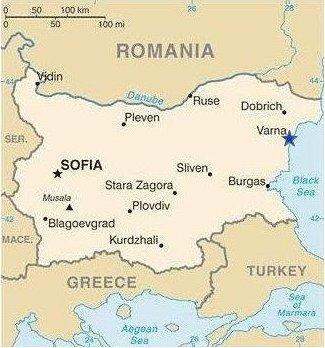
Where is Bulgaria?
Answer
On the map, it’s tucked in Eastern Europe bordering Turkey, Greece, North Macedonia, Serbia, and Romania, with the Black Sea on the east. Its capital, Sofia (where the bride was born and raised), lies in the West near the beautiful Rila Mountains.
Question
Why Varna?
Answer
Maggie was born in Sofia, the capital of Bulgaria. She lived there until she was 10, when she moved to California with her mom. Still, Bulgaria has always remained close to her heart, especially Varna, where she’s spent nearly every summer since. Varna is known as the "Sea Capital of Bulgaria", and for good reason: it has golden beaches, a vibrant summer atmosphere, Roman ruins, delicious seafood, and one of the largest public parks in Eastern Europe — the Sea Garden (Morska Gradina). It’s a city where ancient history and modern life blend together, and where sunrises over the Black Sea feel a little extra magical. When Maggie and Jack met, they traveled to Varna together the following summer. It was Jack’s second time visiting Bulgaria, although it went much better than the first ;) and his first time meeting Maggie’s extended family. From the moment he arrived, he was embraced like one of their own. In fact, her relatives started telling him about Bulgarian wedding traditions before they even knew if he liked shopska salad and rakia (he did). Two years later, Jack returned to Varna and asked Maggie’s father for permission to propose. So it only feels right to bring everyone we love to the place that’s been part of Maggie’s life forever—and the place where our next chapter began. We can’t wait to celebrate with you in Varna, a city that means the world to us.
Question
How Old is Bulgaria?
Answer
Bulgaria is old. Really old. It’s been around since 681 AD, making it one of the oldest countries in Europe still carrying the same name. France and Germany didn’t even exist yet. Highlights through the centuries: The Thracians: Ancient tribes who lived here thousands of years ago. They were fierce warriors, obsessed with gold, and threw parties in elaborate tombs. Of little known fact, Spartacus, yes that Spartacus was born in Ancient Thrace. Saints Cyril & Methodius: Brothers who invented the Cyrillic alphabet over 1100 years ago. It is still used today in Bulgaria, Russia, Serbia, and beyond. So when you can’t read a street sign in Varna, blame them. The Ottoman Era: From the late 1300s until 1878, Bulgaria was under Ottoman rule. This left behind traces in the cuisine (like baklava and kebabs) and traditions. Bulgarians fought hard for their independence. The Communist Era: For about 45 years, Bulgaria was part of the Soviet bloc. Daily life looked a little different then: Russian was taught in every school, shoes and clothes were nearly identical, and bananas were such a rare luxury that families remember getting one as a Christmas treat. It was an era of queues, concrete apartment blocks, and a lot of creativity to make do with what was available — resourcefulness that might come in handy when the bar line gets long at the wedding. Modern Bulgaria: Since 1989, Bulgaria has been a democracy, joining the European Union in 2007.
Question
What should I Eat?
Answer
Shopska Salata – tomatoes, cucumbers, peppers, onions, and an avalanche of shredded feta cheese. For some reason the shred really changes the game. Banitsa – flaky pastry with feta and egg; Bulgarians consider it breakfast, dessert, and life fuel. Incredible stuff. Kebapche & Kyufteta – grilled meat perfection, pretty much the same thing just different shapes (locals might kill me for that generalization but I just tell it how it is). Either with a beer and your golden. Tarator – cold cucumber-yogurt soup. You drink it rather than spoon it. Bulgaria’s natural air conditioning. Excellent hangover cure. Schkembe Chorba - tripe (cow stomach) soup. One of the grooms favorites, he's eaten this a lot due to not honoring Bulgarias number one rule - SIP your Rakia. An even better hangover remedy than Tarator! Bop Chorba - bean soup. One of the brides favorites and yes also a great hangover cure. Tsa Tsa - whole fried smelt straight from the Black Sea. Sold in push carts along the beach, these tasty buggers are pulled from the sea and tossed straight in a frier. Squeeze some lemon, have a Mentha, and you're living like a true Bulgarian. Lyutenitsa – sweet-spicy roasted red pepper spread, basically Bulgarian Nutella. The bride slathers this on everything.
Question
What Should I Drink?
Answer
Rakia — get used to this one. The national fruit brandy. Aka Bulgarian moonshine. The good stuff is all homemade. Good news is that almost everyone makes it. Though the standard rakia is made from grapes, it can be made from anything including apricot, quince, plum, pear etc. Stronger than you think. Sip. I repeat, SIP! Prepare to drink 3-4 small glasses with your salad before dinner. I believe in you. NOTE: The brides late grandpa (Jordan Dimitrov aka "Diado Dancho") made 10 L for each of his 3 grandkids before he passed away in 2013 (apricot, plum, and sour cherry are the offerings). The first to get married got first pick and as the lucky couple we will be enjoying the apricot rakia in his memory. We wish you were with us Diado. Wine — try Mavrud (red) or Misket (white). Plenty of good local wines to choose from. Beer — Bulgaria mostly keeps it simple but solid: you’ll see Astika, Zagorka, Kamenitza, and Shumensko everywhere. They’re crisp light refreshing lagers enjoyed ice-cold either at the beach or with grilled meat and, let’s be honest, as a survival tool after all the rakia rounds. Varna is also the home of Glarus beer — the first and largest craft brewery in Bulgaria. Bulgarian and European craft beers are increasingly available.
Question
Why did someone smack me on the head after my haircut?
Answer
It’s a good-luck tradition to make your hair grow thicker. (Free head massage!)
Question
Why did that woman just spit on a baby?
Answer
It’s not real spit. Just a pss-pss sound to protect the child from the evil eye. The baby is fine.
Question
Why is everyone staring at me when we touch glasses?
Answer
This is serious business. It’s a custom to look each person in the eye when clinking glasses. Don’t break eye contact unless you want bad luck (or just to make things awkward).
Question
Do I need to speak Bulgarian?
Answer
Not really — most people in Varna speak English. But just fumble through a few words (or even just one) and you’ll earn major points. Seriously.
Question
Learn Some Bulgarian?
Answer
Български език (Bulgarian language) uses the Cyrillic alphabet, so at first glance it can look intimidating — all those consonants! But don’t worry: this isn’t France. People in Bulgaria love it when you make the effort, even if you butcher a word or two. Jack pretty much just said “Hello” (Здравей — Zdravey) to every single member of Maggie’s family about 100 times a day — and look where it got him. Bulgarian uses the Cyrillic alphabet, which looks tricky but many letters are familiar once you know the code: Аа → a — as in army Бб → b — as in bath Вв → v — as in very Гг → g — as in gun Дд → d — as in dog Ее → e — as in send Жж → j — as in pleasure Зз → z — as in zoo Ии → ee — as in sweet Йй → y — as in youth Кк → k — as in kitchen Лл → l — as in luck Мм → m — as in meet Нн → n — as in not Оо → o — as in hot Пп → p — as in pot Рр → r — as in robot Сс → s — as in sun Тт → t — as in tall Уу → oo — as in room Фф → f — as in fish Хх → h — as in hat Цц → tz — as in quartz Чч → ch — as in church Шш → sh — as in fish Щщ → sht — as in smashed Ъъ → u — as in ugly Юю → you — as in unit Яя → ya — as in Australia Here are a few words and phrases that will earn you smiles: Здравей (Zdravey) – Hello (to one person) Здравейте (Zdraveyte) – Hello (formal or to a group) Благодаря (Blagodarya) – Thank you Наздраве! (Nazdrave!) – Cheers! (you’ll use this one a lot) Моля (Molya) – Please / You’re welcome Да / Не (Da / Ne) – Yes / No Къде е плажът? (Kade e plazhat?) – Where is the beach? Една бира, моля. (Edna bira, molya.) - One beer, please.