The Sacrament of Marriage
The Orthodox Marriage Ceremony
................
In the eyes of the Church, marriage is the sacramental union between a man and a woman that is used in the Bible as the image of God's faithful love for ancient Israel (Isaiah 54; Jeremiah 3; Ezekiel 16) and Christ's sacrificial relationship to the Church (Ephesians 5). When we say that marriage is a sacrament, we use that word to convey the depths of the covenantal bond the bride and groom are about to enter into: a sacramentum in the ancient Roman empire was the oath of loyalty unto death that a Roman soldier took to the emperor when entering the military. As Christians, the sacrament of marriage is the oath of loyalty unto death the bride and groom make to each other and as a couple - their oath of loyalty unto death to our Lord Jesus Christ, "the King of kings and Lord of lords." Christian marriage is intended to be a sign of God's presence and love in this fallen and broken world. The celebration of the sacrament of marriage is made up of the Service of Betrothal and the Service of Crowning. The text of these two services summarizes in words, images and symbols the Orthodox Christian teaching regarding marriage.
I: The Mystery of Betrothal
................
The wedding begins with the Service of Betrothal, which historically was the Church's formal engagement ceremony. In this service, the priest prays for the couple's peace, harmony, and steadfast love, asking God to bless and "establish" their union.
The Rings
................
The rings are an ancient symbol of the couple's commitment to one another and their desire to enter into the covenant relationship of marriage. As the Prayer of Betrothal indicates, in the Scriptures, rings were given as signs of commitment, authority and forgiveness. The priest will refer to the stories of Old Testament figures such as Isaac and Rebecca, Abraham and Sarah, but also, Joseph, Daniel, and Thamar where rings are signs of authority. Finally, the prayer will reference the Prodigal Son, who had a ring placed on his right hand when he returned to his father. After being blessed by the priest the rings are exchanged between bride and groom. This exchange signifies that in married life the weakness of one partner will be compensated for by the strengths of the other.
The Candles
................
The candles symbolize Christ, "the light of the world," and the gift of the Holy Spirit at Pentecost that must burn in the hearts of the bride and groom to light and guide their path throughout life. It is also a physical manifestation of the spiritual willingness of the couple to receive and be illumined by Christ, Who will bless them through this Mystery.
II: The Service of Crowning
................
The Service of Crowning - the second and longer part of the ceremony - is the actual wedding in the Orthodox tradition. It begins with the invocation of the Holy Trinity, followed by petitions offered on behalf of the bride, groom and wedding company. Three prayers are then read which ascribe to God the institution of marriage and the preservation of His people through the ages. Here, the Church prays that God will unite the couple in "one mind and one flesh," granting them love, peace, and the grace to walk together in faith.
The Joining of Hands
................
The priest joins the right hands of the bride and groom while petitioning God to unite them in oneness of mind and heart. The bride and groom keep their hands joined throughout the rest of the service to symbolize their newly-consecrated unity as a couple in Christ. Since God is the true Celebrant of every sacrament, the priest always expresses himself in the third person. He is simply God's instrument in the service.
The Wedding Crowns
................
The crowning is the central act of the Orthodox wedding service. The crowns are rich symbols of the glory and honor that God bestows upon His faithful people. They are the "crowns of righteousness" spoken of by the apostle Paul in his Second Letter to Timothy, given on the Day of Judgment to those who are faithful to Christ. Sharing in His victory and abiding joy, the bride and groom are crowned as king and queen of the ‘little church’ of their home which they must rule responsibly, with love and wisdom. The crowns are also reminders that the married life is one of self-sacrificial love: the couple, like the martyrs die to themselves for the sake of the other.
The Scripture Readings
................
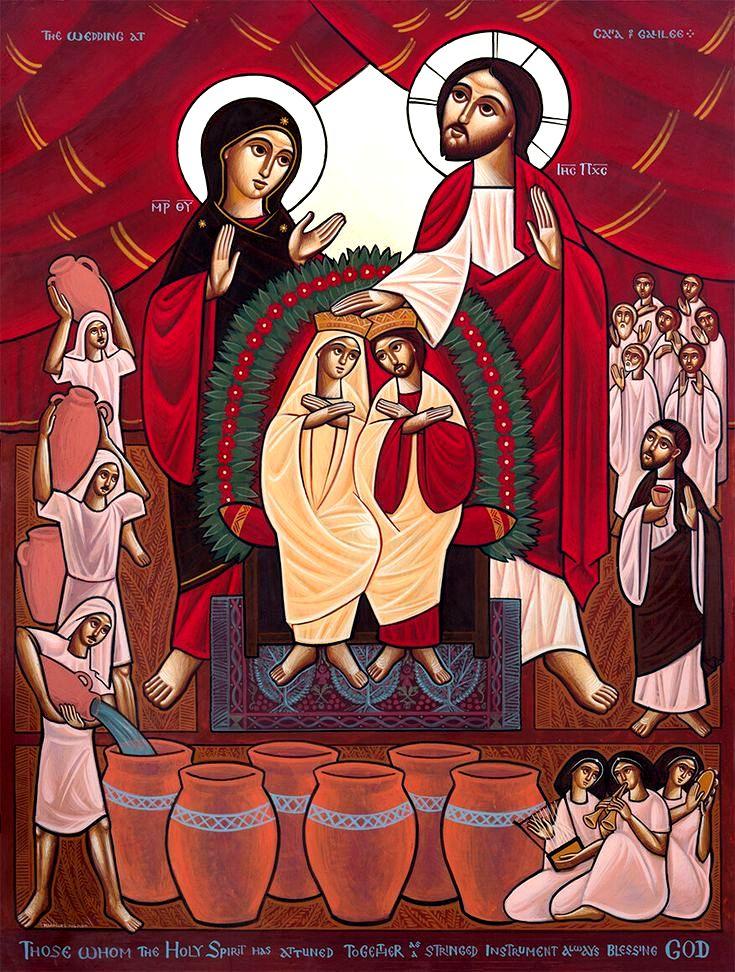
As part of the wedding service, there are two specific readings from the New Testament, which detail the responsibilities of each partner in the marriage and recount Christ's first recorded miracle. The first is from the apostle Paul's Letter to the Ephesians 5:20-33, which describes the relationship between the bride and groom as an image of the relationship of sacrificial love that Christ has for the Church. The second reading is taken from the Gospel of John 2:1-11, which describes the first miracle of the Lord Jesus as taking place at a wedding in Cana of Galilee to which He, His mother Mary and His disciples had been invited. It is here, at the urging of His mother, the Theotokos, that He changes water into wine so that the celebration of the marriage feast may continue, thus beginning His ministry and the revelation of His glory.
The Common Cup
................
Following the readings and brief prayers, the common cup, containing a small portion of wine, is presented to the bride and groom. This is done in remembrance of Christ's miracle of changing water into wine at the wedding in Cana of Galilee and symbolizes their sharing in the cup of life together. From this moment on they will share everything in life; joys as well as sorrows.
The Dance of Isaiah
................
Now joined into one, the priest leads the bride and groom around the wedding table as an expression of joy and celebration. During this procession, a series of hymns are sung. The first speaks of the Isaiah the Prophet's profound joy when he saw the coming of the Messiah upon the earth. The second recollects the martyrs of the Faith, who received their crowns of glory from God through the sacrifice of their lives. Finally, the third exalts the Holy Trinity. Husband and wife take their first steps as a married couple in the Church, following a path laid by the good news of the Gospel.
The Removal of The Crowns
................
As the marriage service begins to near its end, the crowns adorning the couple are removed by the priest, as he prayerfully remembers those honored couples of the Old Testament - Abraham and Sarah, Isaac and Rebecca and Jacob and Rachel - charging the bride and groom to "go in peace, doing the commandments of God."
A Note on Etiquette
................
Traditionally, Orthodox Services are experienced while standing. If you need to sit at any point, there will be chairs available but we gratefully ask that those remain reserved for our elders/those who are truly in need. "The love of husband and wife is the force that welds society together." St. John Chrysostom