Welcome to our wedding


Our Ceremony
Question
Mangala Snanam - 5am
Answer
The day of the wedding starts with the mangal snanam ritual at the crack of dawn at both the groom and bride’s homes respectively. They are smeared with a paste of turmeric, sandalwood and kumkum by the married women of their family and bathed in holy water to cleanse and purify their body and soul; after which they proceed to get ready. Once dressed, the bride prays and seeks blessings from Goddess Gauri, who represents purity and virtue.
Question
Kashi Yatra - 6:45am
Answer
An ancient custom rooted in history, the Kashi yatra is one of the most delightful rituals of a Tamil wedding. Once the groom’s family reaches the venue, the groom grabs an umbrella, walking stick, and food to head to Kashi (Benaras) to renounce worldly pleasures and dedicate his life to god. As everyone looks on, the father of the bride then convinces him to choose a life of domestic bliss instead of being a hermit and promises to give his daughter’s hand to him.
Question
Maalai Maatral / Vilaiyaadal - 7am
Answer
The bride then arrives at the mandapam, where she exchanges garlands with the groom three times amid a lot of laughter and playful antics. Their friends and family help them to evade the garland being put by the other person. The Vilaiyadal is the formal introduction of the bride to the members of the groom’s relatives, who welcome her into the family with gifts. The couple then plays various wedding games steeped in rich tradition.
Question
Oonjal - 8am
Answer
Translating to ‘swing,’ for the Oonjal ceremony, the couple is seated on a swing and rocked gently, as the women of the family surround them and sing traditional songs. Elders feed them milk and banana to bless them, and women carry colored rice balls, earthen lamps and water pots around them three times in both directions. The rocking of the swing represents the trouble they may face in life, and the colored rice balls are thrown in four directions to ward off negativity.
Question
Kanyadaanam - 9am
Answer
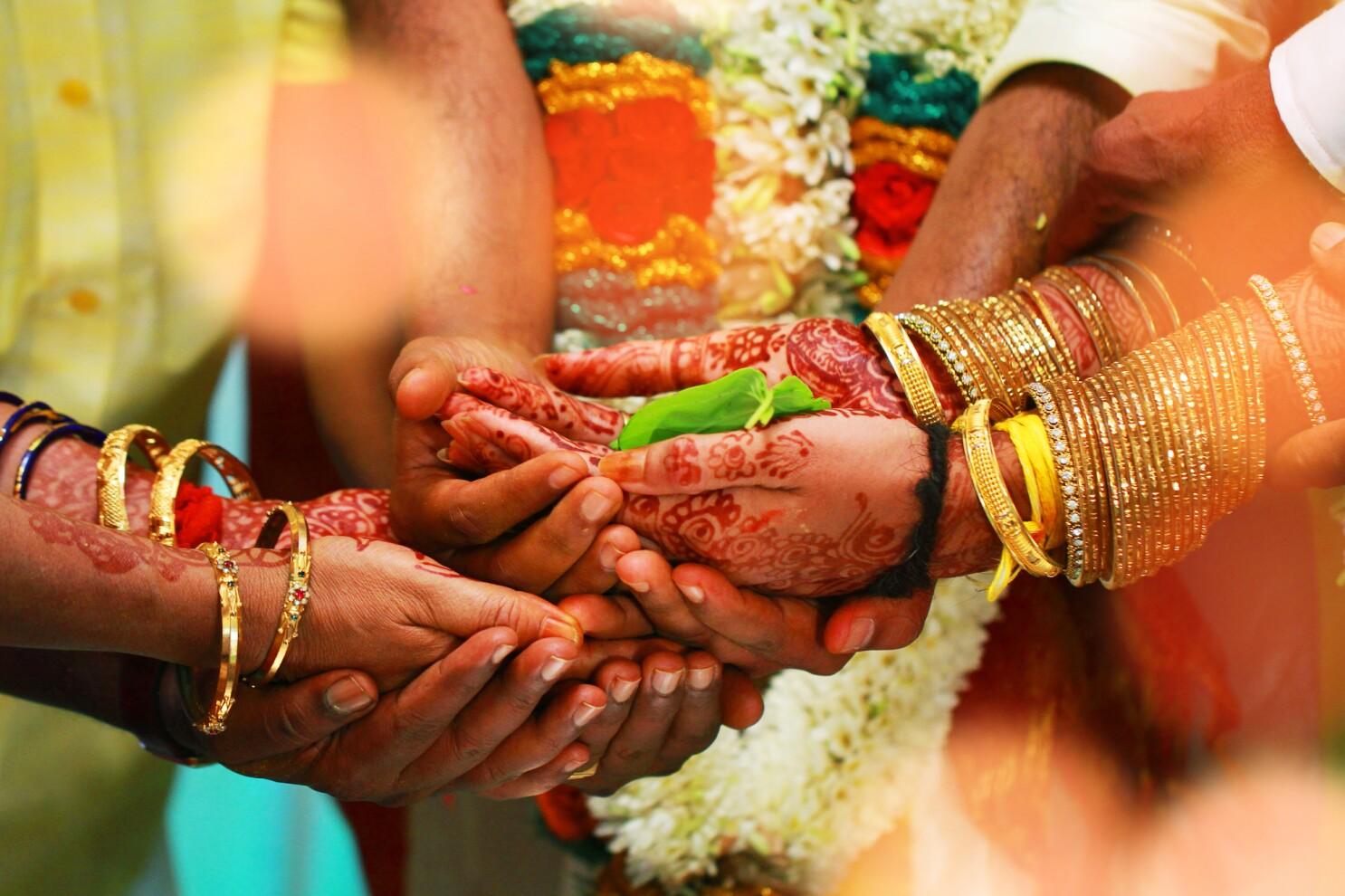
A ritual common to every culture in the world, the Kanyadaanam marks the official giving away ceremony of the bride by her parents to the groom. He is made to sit on the floor where his feet are washed by the bride’s father, who sits opposite him with the bride in his lap. He supports her hands holding a coconut which is then offered to the groom, as her mother pours holy water over it. With this gesture, they officially hand over their daughter for life, asking him to cherish her and protect her. The bride and groom’s hands are tied with a sacred thread to seal their union.
Question
Muhurtham - 10am
Answer
After the Kanyadaanam, the groom’s parents gift the bride a nine-yard silk saree to welcome her into their family, which is draped around her shoulders while the groom applies sindoor on her hair parting. The bride then changes into the new saree and returns for a few more rituals. The thaali (South Indian equivalent of mangalsutra) is then blessed by the priest and tied around her neck by the groom. The first two knots of the Thaali are put in by the groom, while the third and the final one is put in by the groom’s sister.
Question
Saptapadi - 10:30am
Answer
The bride and the groom hold hands and take seven steps around the holy fire while the priest chants Vedic mantras in Saptapadi, one of the most important rituals in a Hindu marriage. The groom then holds the bride’s left toe as she steps over a grindstone, symbolizing the solidity of their union.