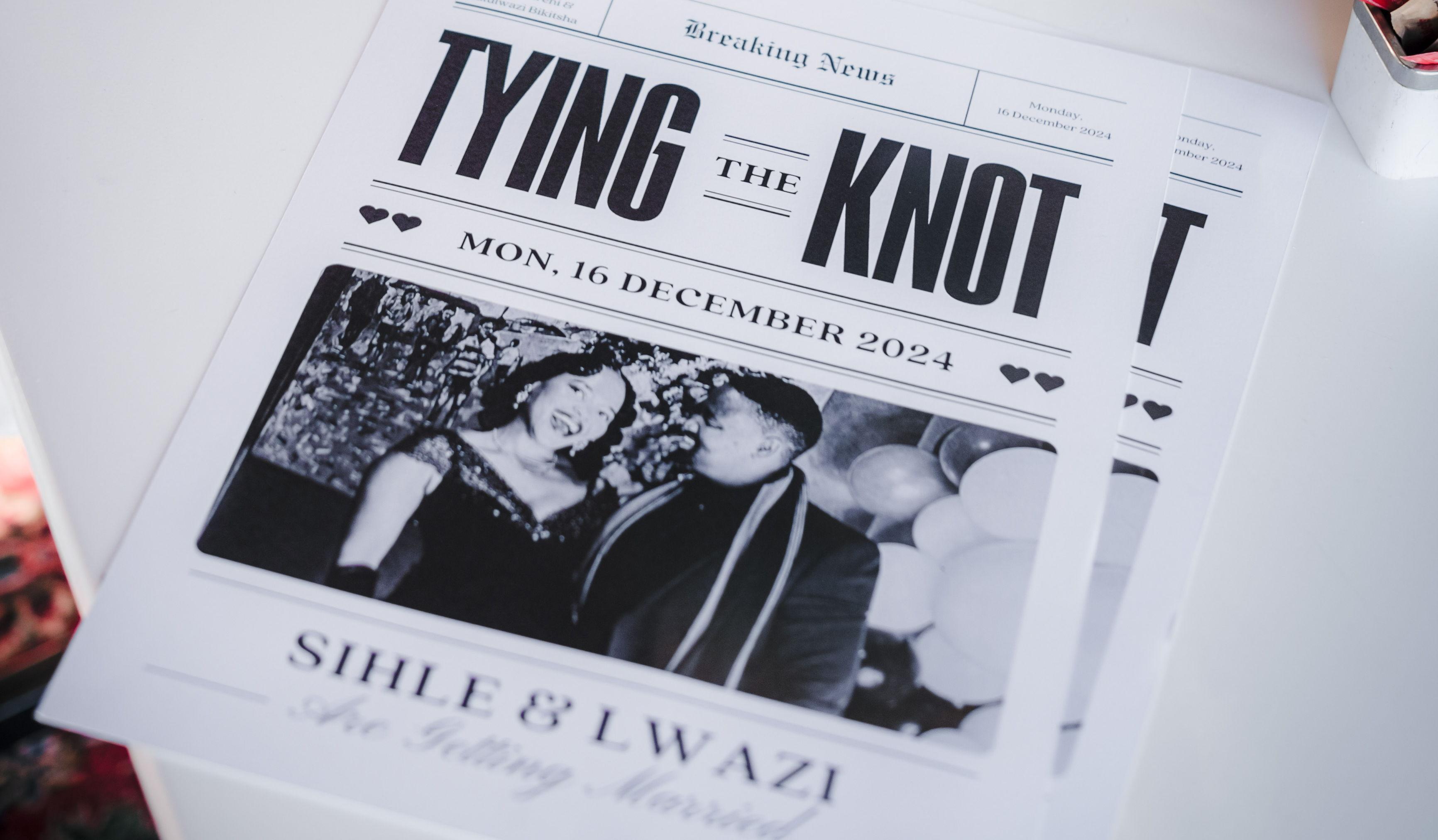
Sihle-isipho & Lwazi
Come Celebrate With Us
Lwazi Bikitsha
Sihle-isipho Nontshokweni
December 18, 2024
The Proposal
His Story
The 30th of November, 2016, was as hot as any summer’s day, but the air felt different. I had driven into East London the day before to attend my aunt’s wedding. It was an afternoon event, and I spent the morning searching for a shirt to complement my navy blue suit. The traffic was backed up, and the stores in the mall were crowded, but I was determined—I had to make a statement. I was so focused that I barely had time to pick up a gift, so in the end, I settled for something from Woollies. I drove to Cypress Dale Country Venue with my baby sister and cousin brother, excitement in my heart, with the sounds of Wizkid filling the air during the short drive. We arrived at the venue on time, ready for a great day ahead—and boy, did we dance the night away. Ivosho was the dance of the moment, but to avoid ripping my pants, I wisely sat that one out. As the procession was about to begin, my baby sister pointed to a lady sitting in the row in front of us on my left and asked if I knew her. The lady turned around, smiled, and I said, "No." I smiled back and introduced myself, and she responded with a sweet, "Hi." An hour later, the sun was beating down on us, and I noticed this same lady shrugging her shoulders in discomfort. I offered her my blazer to shield her from the sun, and she accepted graciously. My baby sister, ever chatty, proudly mentioned how this lady had driven all the way from Cape Town to East London. I, however, was less impressed by her long drive and became concerned when I saw her green car. Her bright and proud spirit tried to lift me up, but all I could feel was worry. The wedding carried on late into the night, and when it was time to leave, the roads were dark. The headlights on her green car were dim, and I insisted that my cousin drive her car. Instead, he was asked to guide her on the road back to town. A few months later, on my birthday, a friend asked me what I wanted. I jokingly replied, “I’d like a big sister for my baby sister.” Little did I know that the same lady from the wedding would soon become a mentor and coach to my baby sister. When I found you, I found the answer to my most intimate prayer. Years passed, but the heart doesn’t forget. I met the same lady again, this time under less desirable circumstances. We exchanged smiles, and before she could greet me, I asked, “Are you spoken for?” I don’t remember her response, or if she even gave one, but I do remember my aunt’s irritation at my bold question—the same aunt whose wedding we had attended. The lady and I spoke for a while, but she excused herself to greet a few people. Sensing an opening, I decided to leave. She must have been annoyed by my abrupt departure because a few hours later, I received a text asking why I had left without saying goodbye. I think I knew then that this encounter was different, and so was this remarkable woman—she was my wife.
Her Story
For some, it begins as a hot ardent flame; for others like myself, it was a slow amber. Then, one day, my eyes peeled open, and I realised that right in front of me was the love in the shape my heart had always longed for. In 2019, I bumped into Lwazi at a friend's parent’s funeral. We were between the white tent, black plastic chairs, and red sand. On unlevelled ground, with a quiet smile (characteristic of him), he asked, “Are you spoken for?” The language bypassed my understanding. Our mutual friend, Vee, was unimpressed by this peculiar question. Why ask such a thing at a funeral, of all places? Lwazi was not deterred by this side-eye. He soon slipped away without saying goodbye, so I messaged him later, “wasishiya njekanjalo?” Maybe this was my way of lingering onto the question. Perhaps I, too, had an interest in being spoken for. A few months before that, I had bumped into his older brother, Tando, at the Toni Morrison memorial. Later, Lwazi messaged me, “You should meet my whole family and stop doing so in pockets, yaz...” Who would have thought that six years later, I wouldn’t only be meeting the family in full dose, but also asking to become theirs, to carry their name as my own and alike become a Bikitsha. “I want a home,” he once said earnestly. “A home to come back to—a home of my own, with my wife and chubby little baby girls with pigtails. I don’t want to be a rolling stone.” By this time, my friends had already pointed out that Lwazi was a "walking husband." We joked about how he rolled out of his mother’s belly ready to lead a home—hahaha. In these reflections, the curtain of consciousness glowed open, swept me into the portal of mystery where love awakens in the recesses of the spirit. I had been praying. After years of kindness, teddy bears (Americana our first baby doll), video compilations of the Bikitsha family being coerced into wishing me luck for international trips, sunrise walks and the most sincere love notes—one reading, “What are you doing for the next 60 years? I’d like to spend mine with you”—I could go on describing how Lwazi has built the home of our love, brick by brick. With each act of kindness, Lwazi quietly entered the back door of my heart, bypassing the ordinary “boy meets girl” storyline. Steadily and vigorously, he built the palace of our love, and adorned me as his princess, and we, together, awoke into the dream that is walking our life path together. Inevitably, the lights of my heart switched on. All at once, the rhythm of our love was forged in me, syncopated by the years beneath the years, the love beneath the love, the kindness beneath the kindness, the unconscious beneath the conscious, and the smile beneath the smile that make me fall deeply in love with him. Life together has felt like a lens through which I can see the world more intimately, loving it and people more earnestly. His love has been a benediction, an awakening to the truth that love is not meant to be a crumb. It is a table laid out, an encounter with goodness that keeps opening, opening, opening.