Kaley & Devon
Things To Do

Sunset Watersports
Sunset Watersports Key West offer: All Day "Do it all" Trips (11 activities) Dolphin watch boat tour Dinner Cruise Parasailing Jetski Tour Snorkeling Sunset Sail Speed boat tour See Website for Address verification

Conch Tour Train
See the Best on the train tour that's been entertaining visitors to the Island City of Key West, Florida since 1958. The Conch Train is one of Florida's most popular attractions, and for good reason. Our expert 'engineers' and friendly staff have delighted over 15 million guests with legends such as Ernest Hemingway and lores of this charming tropical paradise. Your tour of Key West will give you a conch's eye view of all the wonderful Key West attractions.

The Hemingway Home and Museum
The Ernest Hemingway House was the residence of American writer Ernest Hemingway in the 1930s. The house is situated on the island of Key West in Florida. It is also famous for its large population of so-called Hemingway cats, many of which are polydactyl. The residence was constructed in 1851 in a French Colonial style by wealthy marine architect and salvager Asa Tift. From 1931 to 1939, the house was inhabited by Hemingway and his wife Pauline Pfeiffer. They restored the decaying property and made several additions. During his time at the home, Hemingway wrote some of his best received works, including the non-fiction work Green Hills of Africa, the 1936 short stories "The Snows of Kilimanjaro" and "The Short Happy Life of Francis Macomber", and the novels To Have And Have Not and Islands in the Stream. After the Hemingway's divorce and deaths, the house was auctioned off and subsequently converted into a private museum in 1964.
Dry Tortugas National Park
Dry Tortugas National Park is a national park in the United States about 68 miles west of Key West in the Gulf of Mexico. The park preserves Fort Jefferson and the seven Dry Tortugas islands, the westernmost and most isolated of the Florida Keys. The archipelago's coral reefs are the least disturbed of the Florida Keys reefs. The park is noted for abundant sea life, tropical bird breeding grounds, colorful coral reefs, and legends of shipwrecks and sunken treasures. The park's centerpiece is Fort Jefferson, a massive but unfinished coastal fortress. Fort Jefferson is the largest brick masonry structure in the Western Hemisphere, and is composed of more than 16 million bricks. Among United States forts it is exceeded in size only by Fort Monroe, Virginia, and Fort Adams, Rhode Island. The park is accessible only by seaplane or boat. Activities include snorkeling, picnicking, birdwatching, camping, scuba diving, saltwater fishing and kayaking.

Southernmost Point of the Continental US
The Southernmost Point Buoy is an anchored concrete buoy in Key West, Florida, marking the southernmost point in the continental United States, the lowest latitude land of contiguous North American states. It is 18 feet above sea level. The large painted buoy was established as a tourist attraction in 1983 by the city at the corner of South Street and Whitehead Street. It is one of the most visited and photographed attractions in the United States. The southernmost point was originally marked with a small sign, before the City of Key West erected the now famous concrete buoy in 1983. The concrete buoy has overall withstood several hurricanes and is a gathering place for photographs and tourists. Cuba is roughly 90 miles south of this point in Key West, although this was not originally on the marker, but rather on a smaller sign next to marker.

The Key West Butterfly and Nature Conservatory
The Key West Butterfly and Nature Conservatory is a butterfly park that houses from 50 to 60 different species of live butterflies from around the world in a climate-controlled, glass-enclosed habitat. The conservatory includes flowering plants, cascading waterfalls and trees. There are also several species of free flying "butterfly friendly" birds, such as American flamingoes, red-factor canaries, zebra finches, cordon-bleu finches and "button" or Chinese painted quail.
Audubon House & Tropical Gardens
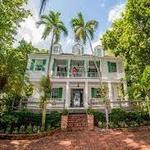
The Audubon House & Tropical Gardens has brick-pathed gardens offering a lush 1-acre view of orchids, bromeliads, and other tropical foliage, an herb garden and 1840-style nursery. The house has many antique furnishings purchased from estate sales and auctions in Europe. The house contains 28 first-edition works of the famous ornithologist John James Audubon. Audubon visited the Florida Keys and Dry Tortugas in 1832 and left Key West having sighted and drawn 18 new birds for his "Birds of America" folio. It is believed that many of those drawings were conceived in the Audubon House garden. Also, Audubon's painting of the white-crowned pigeon features the Geiger tree found in the front yard of the house. The Audubon House Gallery, separate from the main house features a unique collection of 19th century original Audubon art and a comprehensive selection of John James Audubon's images.

Key West Tropical Forest & Botanical Garden
The Key West Tropical Forest & Botanical Garden is a frost-free arboretum and botanical garden containing a collection of trees, shrubs, and palms, including several "champion tree" specimens. It is located on Stock Island in the municipality of Key West, Florida, United States. It is open daily.

Fort East Martello Museum
While Key West remained a Union-controlled island during the Civil War, the majority of Key West citizens supported the Confederacy. With such a rift, it is perhaps surprising that no battles took place on or around the island. Having no use for the Fort once the war was drawing to a close, Fort East Martello was abandoned in its unfinished state by the Army. In 1950, the Key West Art & Historical Society, with its own army of volunteers, cleared away years of debris and dust to open Fort East Martello as its first museum. With continued community support, the Society restored this national landmark in accordance with its original 1860s design. Today, visitors can explore the preserved battlement’s collection of relics from the Civil War, learn about the wrecking and cigar-manufacturing industries which shaped the Florida Keys, view the imaginative metal sculptures of Stanley Papio, as well as meet the Ghosts of East Martello, including the infamous Robert the Doll.

Fort Zachary Taylor Historic State Park
The Fort Zachary Taylor Historic State Park, better known simply as Fort Taylor is a Florida State Park and National Historic Landmark centered on a Civil War-era fort located near the southern tip of Key West, Florida.

Mallory Square
Mallory Square is a plaza located in the city of Key West, Florida, U.S. It is located on the waterfront in Key West's historic Old Town, adjacent to the cruise ship port. It is located just west of the northern end of Duval Street, facing the Gulf of Mexico. It runs the entire length of Wall Street. Adjacent to the square are the Key West Shipwreck Historeum Museum and the Old Post Office and Customshouse. Don't forget to visit during Sunset Celebration in hopes to see the "green flash"!

Truman Little White House
Originally, it was constructed in 1890 as naval officers housing. Important visitors have included extended stays by inventor Thomas Edison and scientist Edward Hayden and it has been used by six American presidents. Its most important usage was as the winter White House of Harry Truman who spent 175 days of his presidency here from 1946 through 1952. Harry Truman faced the rebuilding of Europe, the Palestine question, issues of Civil Rights and labor unrest changes in foreign policy and our response to the Cold War. Other presidents have included William Howard Taft in 1912, Dwight Eisenhower in 1955-56, John Kennedy in 1961 and 1962 and former Presidents Jimmy Carter in 1996 and 2007 and Bill Clinton in 2005. All have found it a restful place to restore body and mind as later presidents have used Camp David. It was the site of international peace talks between the presidents of Armenia and Azerbaijan in 2001.

Key West Lighthouse
The current lighthouse opened in 1848 with a woman as its Keeper; nearly unheard of during the 19th century. In the years following, the Key West Lighthouse underwent a number of upgrades including the installation of a Third Order Fresnel Lens, an extension to the tower which allowed the light to be seen from a greater distance, the addition of Keeper’s Quarters, and finally the electrification of the light. In 1969, the U.S. Coast Guard decommissioned the Key West Lighthouse since there was no longer a need for a full-time Keeper due to technological advancements. Today, this sentinel of the sea stands as a museum dedicated to Key West’s maritime heritage and to the men and women who bravely kept the light burning through the threats of war and weather. Today, visitors can walk up the 88 steps to the top of the light as well as explore the belongings, photographs, and words of the lighthouse Keepers and their families who lived a now obsolete, yet never forgotten, way of life.

Mel Fisher Maritime Museum
The Mel Fisher Maritime Museum contains an extensive collection of artifacts from 17th century shipwrecks, such as the Henrietta Marie, Nuestra Señora de Atocha and Santa Margarita. Also included are the shipwrecks and artifacts of The Santa Clara, a Conquistador-era galleon, The Guerrero & Nimble. A rotating gallery exists on the second floor of the museum and is currently displaying an exhibit or artifacts belonging to Cuban Rafters, Balseros, who arrive to Key West in hand-crafted vessels. It is a museum, a lab, and a nationally recognized research facility. Within the museum is a fully operating Conservation and Archaeology lab, where guests are allowed admittance during a daily private Lab Tour and are able to touch the artifacts while learning about the various stages of artifact conservation.

Key West Shipwreck Museum
The Key West Shipwreck Museum combines actors, films and actual artifacts to tell the story of 400 years of shipwreck salvage in the Florida Keys. The museum itself is a re-creation of a 19th-century warehouse built by wrecker tycoon Asa Tift. Many of the artifacts on display are from the 1985 rediscovery of the wrecked vessel Isaac Allerton, which sank in 1856 on the Florida Keys reef and turned out to be one the richest shipwrecks in Key West's history, having resulted in the Federal Wrecking Court's largest monetary award for the salvage of a single vessel. Also included are relics from Spanish galleons, including a silver bar salvaged from the Nuestra Senora de las Maravillas that guests are encouraged to try to lift. The museum guide portraying Tift tells the story from his point of view as he explains how this unusual industry provided for the livelihood for the entire island of Key West at a time when it had the largest population in the state.

Key West Museum of Art & History at the Custom House
Originally home to the island’s customs office, postal service, and district courts, this four-story architectural marvel was built to keep pace with the increasing population and wealth accumulating from Key West’s lucrative trade routes and maritime industries. The imposing structure is a tremendous exemplar of Richardsonian Romanesque architecture which was typical for Federal building projects near the end of the 19th century. Positioned adjacent to the U.S. Naval base, the Custom House was the site of many significant historical events, most notably the inquiry into the sinking of the USS Maine in Havana harbor in 1898. In 1932, the building transferred to the U.S. Navy and became headquarters for their Caribbean and Gulf of Mexico operations. When the Navy no longer required use of the building, it was declared surplus and abandoned for nearly twenty years. Experience two floors of exhibitions that weave together two centuries of history, art, people, and events.

Key West Cemetery
Located in Old Town, the Key West Cemetery has been around since 1847 and is well worth at least a walk-through. The quirkiness of the city's residents extends even to the grave. Tombstones in this 19-acre cemetery don't wear the typical inscriptions. Instead, you'll find epitaphs that reflect the island's casual lifestyle. Some of the more well-known inscriptions include "I told you I was sick" and "I'm just resting my eyes." One tombstone is actually a ship's mast. Many recent travelers compared the cemetery to those found in New Orleans, thanks to the prevalence of the above-ground graves. Reviewers also said it reflects the "eclectic" citizens of the Keys. Key West Cemetery is free for anyone to walk through, but you should also consider taking a guided tour, offered on Tuesdays and Thursdays. You can also pick up a map for a self-guided tour at the cemetery's front office.

USCGC Ingham Maritime Museum
USCGC Ingham is one of only two preserved Treasury-class United States Coast Guard Cutters. Originally Samuel D. Ingham, she was the fourth cutter to be named for Treasury Secretary Samuel D. Ingham. She was the most decorated vessel in the Coast Guard fleet and was the only cutter to ever be awarded two Presidential Unit Citations.

Key West First Legal Rum Distillery
105 Simonton St is the original location of Jack's Saloon in 1900 and Key West's Original Coca Cola bottling company in 1903. Finally, 90 years after Prohibition, in 2012 Key West First Legal Rum opened its doors. Key West, legal Rum and Coca-Cola, together at last.
