FAQs
Question
Who is Marrying You?
Answer
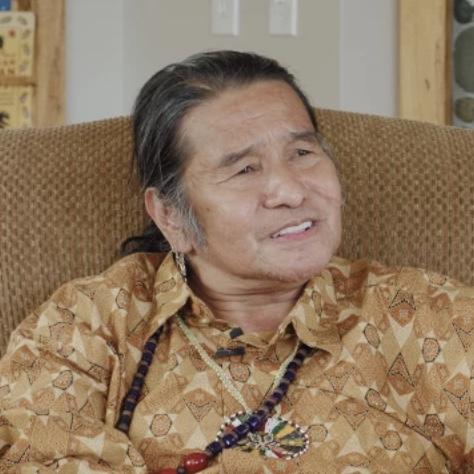
About Johnny Moses Mark first met Johnny about 8 years ago, and introduced Catherine six years ago. Johnny holds a special place in our hearts. First and foremost, Johnny is a warm, funny, kind human being, the kind of wise soul that one would wish for in a ceremony of this level of personal significance, and the kind one is honored to call a friend. We love you, Johnny. A little background: Johnny Moses, "Whis.stem.men.knee" (Walking Medicine Robe) is a Tulalip Native American raised in the remote Nuu-chah-nulth village of Ohiat on the west coast of Vancouver Island, B.C., Canada. He was raised in the traditional ways by his great grandparents, and sent by his elders to share their teachings with all people. Johnny is a master storyteller, oral historian, traditional healer and respected spiritual leader. Fluent in eight Native languages, he is a traveling ambassador for Northwest Coast cultures. He shares the knowledge and richness of his spiritual and cultural traditions with people across the United States, Canada and around the world, through storytelling, lectures and workshops. Thank you Johnny, from our hearts to yours E Hych Ka (Thank you, coastal Salish) Lim’limpt (Thank you, interior Salish)
Question
Who are the First Nations of the area where you live?
Answer
In the serene embrace of the waters, mountains, valleys, and shorelines of the Great Northwest, we seek solace through kayaking, hiking, camping, and tending to our apple orchard back home, all while gazing upon the Salish Sea. Yet, we acknowledge that these lands, our cherished home, encompass more than mere picturesque landscapes—they are the sacred, ancestral territories of the Chemakum (Aqokúlo or Čə́məq̓əm) and S’Klallam (Nəxʷsƛ̕áy̕əm̕) peoples. Over time, various Indigenous nations, including the Snohomish (Sdoh-doh-hohbsh), other Coast Salish communities, and the Makah (Qʷidiččaʔa·tx̌), have traversed, traded, and nurtured these lands. We deeply respect the enduring presence of all Northwest Indigenous peoples, honoring their profound connection to this land since time immemorial. Acknowledging the unjust colonization of these lands, we confront the scars of history—genocide, forced displacement, and the atrocities of Government and Church Indian Schools—all aimed at erasing the vibrant cultures and resilient nations predating European dominance. We stand in solidarity against the ongoing, harmful impacts of settler colonialism, advocating for Indigenous sovereignty. Witnessing firsthand the resilience of these peoples and cultures, we recognize their strength and vitality. Contrary to popular misconceptions, Pacific Northwest native cultures are healing and revitalizing, offering much to a world in need. We have been blessed to witness this cultural vitality and strength firsthand. Through our commitment to learning and action, we embrace our responsibility as settlers on this sacred land, pledging to honor and uplift the Indigenous experience. With humility and respect, we extend gratitude and friendship to our Chemakum (Aqokúlo or Čə́məq̓əm) friends and neighbors who are celebrating alongside us on this 21st of July, 2024. E Hych Ka (Thank you, coastal Salish) Lim’limpt (Thank you, interior Salish) Mark and Catherine
Question
Tell me about the Olympic Peninsula?
Answer
Here are some facts about the Olympic Peninsula: It's a large arm of land in western Washington that's across Puget Sound from Seattle. It's home to temperate rain forests, including the Hoh, Queets Rain Forest, and Quinault. The Olympic Mountain range is located in the center of the Olympic Peninsula. The tallest mountain on the peninsula is Mount Olympus, which is 7,980 feet tall. The Olympic Peninsula has over 3 million visitors every year. Olympic National Park is located on the Olympic Peninsula and includes 922,650 acres of land. The park has 60 named glaciers and over 650 archeological sites. 95% of the park is designated wilderness area. Hurricane Ridge is one of the most popular park destinations. Olympic National Park was made a national park on June 29, 1938. President Franklin Roosevelt signed the act establishing Olympic National Park, and then expanded the park in nearly all directions over the next five years. You can explore a good portion of Olympic in three days, but an extra day can make a big difference. The Wynoochee area is a remote getaway in the southern area of the Olympic Peninsula that provides opportunities for swimming, boating, and fishing. The northeastern parts of the Olympic Peninsula lie in a dry rain shadow, while the rest of the peninsula gets an average of 30-35 feet (10 m) of snow annually.
Question
What should I wear?
Answer
This is a very casual affair. We will be outdoors, so hats are welcome, Sunglasses if you wish (remove for group photos). Sturdy footwear, because the ground is a bit uneven. Weather here in July is typically very pleasant, in the high 60s to low 70s. Please bring layers, as it may feel cool in the evening. And, once in a blue moon, there is an actual heat spell, into the high 80s. Though there is a very low chance of rain in July, anything is possible at this latitude. This is a rural and rustic type of wedding, so, overall, dress comfortably, bringing layers just in case.