Gurdwara & Anand Karaj Information
Question
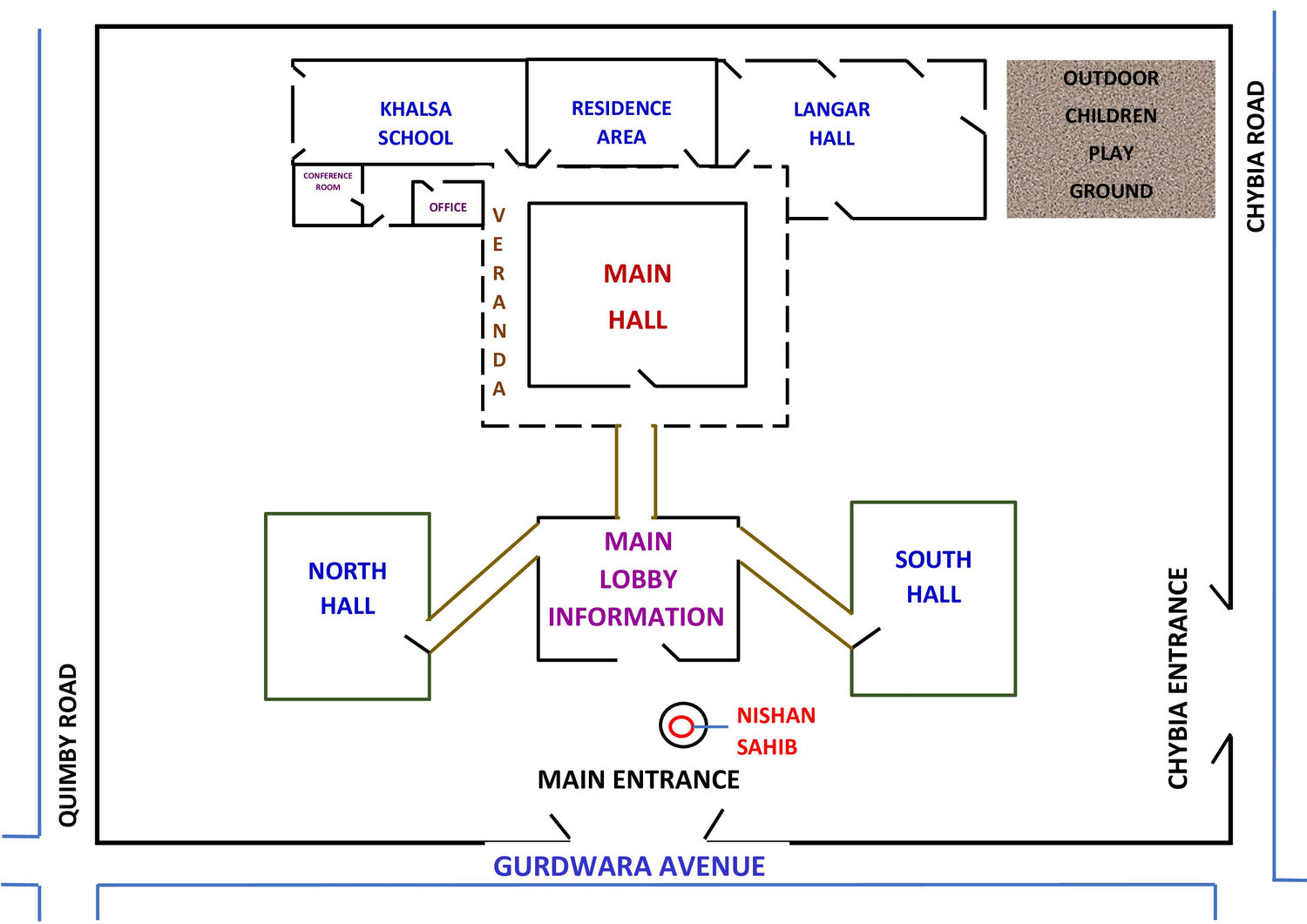
Where in the Gurdwara will the wedding be?
Answer
The ceremony will take place in the main hall. Breakfast and lunch will be in the south hall. See above for the layout.
Question
What is the etiquette for the gurdwara?
Answer
We treat Guru Granth Sahib Ji (our scripture) as a living embodiment of the divine. In accordance with this, please keep your head covered at all times when inside the hall. Please do not wear shoes inside the hall (there are designated spaces to take off your shoes before you enter). Customarily, women sit on the right side and men on the left, but it is totally okay to sit on the other side if you would like. There will be multiple times during the ceremony when we do Ardaas (prayer). During these times, the sangat (community) all stand and face towards Guru Granth Sahib Ji. At the conclusion of the Ardaas, the sangat kneels on the floor and bows. If you do not feel comfortable bowing at the end, please feel free to go from standing to sitting.
Question
What is the Anand Karaj?
Answer
The Anand Karaj, or “ceremony of bliss,” is the Sikh marriage ceremony. With reverence, prayer, love, and community, the couple starts their journey together. The aim of the journey is to see Ik Onkar (the divine One) in all people and all things, embody divine Light, surrender duality in favor of Oneness, engage in seva (service), work towards justice, and be partners in spiritual blossoming. The marriage ceremony itself consists of four Lavaan. Each Laav represents a stage of the spiritual journey to connect with the Light. These stages also mirror the couple’s journey. Each Laav is first read, then sung. The Lavaan are sung in a raag (musical mode) called Suhi, which is associated with deep love and devotion. While the Lavaan are sung, the couple walks around Guru Granth Sahib Ji (our living scripture). This represents the couple making spiritual wisdom and love the center of their lives. Other parts of the anand karaj will include kirtan (singing of divine poetry from Guru Granth Sahib Ji), hukamnama (reading of a message from Guru Granth Sahib Ji), and ardaas (prayer). The following are summaries of the Lavaan (not line-by-line translations). They are partially adapted from the Sikh Research Institute. For more information, please see https://app.gurugranthsahib.io/bani/SuhiM
Question
What is the meaning of the Lavaan?
Answer
First Laav: We are made aware of the need to break with our existing dualistic patterns, and instead connect with the divine, natural order of the universe. In this first step, we are advised to sincerely center our lives on dharmic teachings and meditation on Ik Onkar, through which the mire of dualistic karmic patterns can be washed away. The closing lines remind us to re-orient our lives towards Naam (remembrance and connection to the natural divinity surrounding us), through which we may experience the sweetness of Naam and Sehej Anand (intuitive bliss). Second Laav: Having internalized the teachings gleaned from re-orienting our lives in the first laav, our perspective expands and we aim to shed our haumai (ego, or sense of separateness from the world). Grappling with existential fear, we find peace in the realization that there is only Ik Onkar. The separateness between our internal world and the world we see around us dissipates, and we become one with the sweetness and joy of the Anhad Shabad (infinite, intuitive song/vibration) that resounds within us. Third Laav: Letting go of our fears in the second laav, we develop a longing for the transcendental peace of detachment from material desires, and union with Ik Onkar. We find ourselves surrounded by Ik Onkar, and our actions begin to be effortlessly aligned with this new intuitive understanding. Our hearts resonate with this connection, flowing with the constant unraveling and blossoming of the universe. Fourth Laav: We find ourselves arriving home in the fourth Laav, suffused with love. The seeker has realized Ik Onkar, attaining enlightenment. Our mind and body are in tune with the intuitive song of the universe, and we are blessed with the fruits of our desires: finding a permanent place of rest in the ever-blooming Sehej Anand. Wisdom-orientation, and experiencing the sweet all-pervasiveness of the Light, become part of our nature. There is no separation. The waves are part of the Ocean.