Annie & Georges
Things To Do
Les Halles Sainte-Claire
Looking for some charcuterie? Head to Les Halles Sainte-Claire. Not only is the building beautiful, but inside is a giant market where you can find some local treats.
Cave et Distillerie de la Grande Chartreuse
Visit the longest liqueur cellar in the world, and the distillery of the Chartreuse Monks. The guided tours of the cellars include a complimentary liqueur tasting. Discover an exciting video about the mysterious recipe for the liqueur, plus a dramatic movie tracing the history of the secret manuscript. (Presented in a specially built air-conditioned theatre). Open everyday from 10:00 am to 12:30 pm and from 2:00 pm to 6:30 pm.
Spas at Aix-les-Bains
Famous for its hot springs with recognised beneficial properties, Aix-les-Bains is the number two spa town in France. Dedicated to well-being, the town enjoys a lovely location between lake and mountains and offers numerous attractions. It caters comprehensively for both hydrotherapy patients and holidaymakers, with Roman remains, museums, a luxurious casino, pedestrian shopping streets, balneotherapy centres, beautiful Belle-Époque hotels illustrating the town's prestigious past, as well as a sandy beach and a pleasant esplanade lined with plane trees on the edge of Bourget lake.
La Bastille
In the heart of Grenoble you will find La Bastille, a small fortified mountain located at the crossroad of three valleys, served by the first urban cable-car in the world. In a few minutes, day and night, the famous “bubbles” of Grenoble take you in the air from the center of the town up to the Bastille fortress. From the hilltop, discover the flattest town in France in its mountain setting! When the sun sets and the lights go down in the city, the view is outstanding.
Musée de Grenoble
Interested in getting your art on? Check out the Musee de Grenoble! Home to a collection of ancient, modern and contemporary art, the Museum of Grenoble takes visitors on a journey through Western painting from the 13th to 20th centuries. See samples of the museum’s 900 works, including many by prominent figures responsible for defining their artistic eras. The art house was founded in 1796, making it one of France’s oldest museums. At the time, it was also the first French museum outside of Paris devoted to modern art. In 1994, the museum moved from the 19th-century building it had occupied for more than century. Visit the treasured works in their new home. Sunday is one of the best days to visit the Museum of Grenoble because free guided tours are available with the admission price. The museum is located along the riverbank, in Place de Lavalette, and can be reached by both bus and tram.

O'Callaghan Irish Pub
A trip to Grenoble would not be complete (for Georges at least) without a stop at O'Callaghan Irish Pub (otherwise known as "Le Callag'") for a casual beer or (depending on the hour) glass of chartreuse.
City Garden
Located at the bottom of Bastille Hill, Jardin de Ville is a historic garden that once belonged to the 17th-century property of the Duke of Lesdiguières and now hosts a 5-day music festival. Look for the bronze statue La Fontaine du Torrent, which was created by local sculptor Urbain Basset in 1878. The fountain depicts a young man holding a jar on his shoulder as he empties out the water inside. Check out the pretty rose garden that faces the former Hotel de Lesdiguières, a residence that was originally built for military commander François de Lesdiguières. The building later became the administrative headquarters of the Dauphiné region, serving as Grenoble’s city hall until 1967. Beginning in 1970, Hotel de Lesdiguières housed a museum and local library.
Restaurant Caffè Forté
“Lieu unique et plein de charme au coeur de la Ville de Grenoble. Le style est décontracté mais branché tout comme la cuisine gourmande du chef.” — LE PETIT FUTÉ —
Les BerThoM Grenoble
Near the Notre Dame cathedral of Grenoble, this beer bar is open every day with happy hour from 7-9 p.m. Monday to Friday.
Eglise Notre Dame
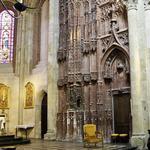
Also known as Grenoble Cathedral, Eglise Notre Dame has long been an important place of worship for the people of Grenoble. Along with neighboring St. Hugues Church, Grenoble Cathedral is part of a double church system, in which two churches were built side by side. While the double church system was a common design in the early Christian era, few remain as well preserved as this complex in Grenoble. Visit the two buildings which belong to a larger cathedral complex, also including the remains of the city’s first baptistery, from the 4th century.